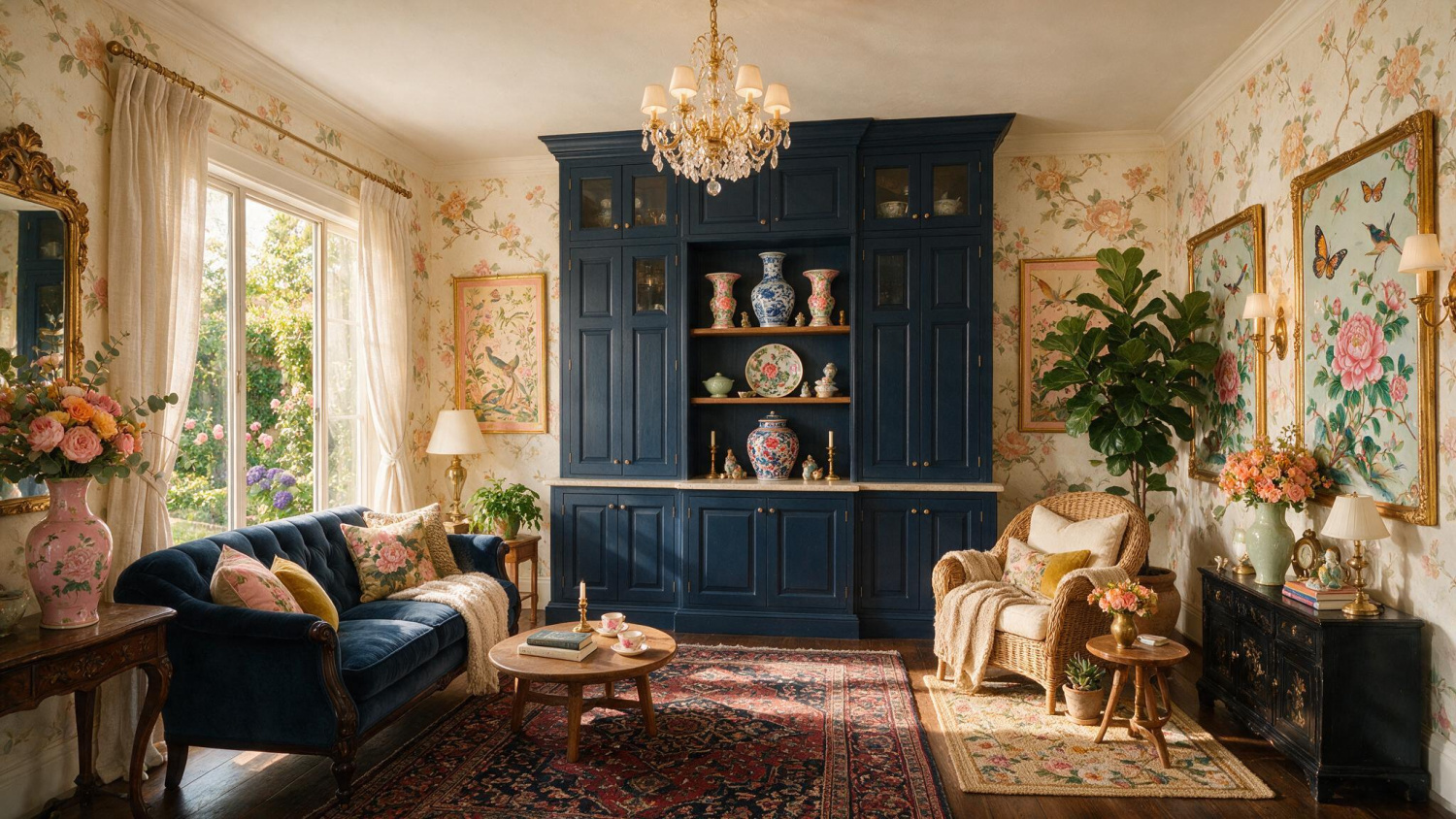
A new fashion in home decoration has arrived, and it is named after your relative. Before we object to it, it seems only fair to explain what it is.
There is, at the time of writing, a dachshund available from Anthropologie whose sole function is to hold a roll of lavatory paper. It has been cited, in print, by a serious publication, as evidence of a movement.
Some readers will need that unpacked, so let us begin at the beginning.
What is actually being described
For roughly a decade, fashionable interiors were empty. Walls were white or the colour of porridge. Surfaces were clear. Everything matched, nothing clashed, and the governing ambition was that a room should photograph well and reveal nothing about whoever slept in it. The style acquired several names — minimalism, the clean look, quiet luxury — and, from its detractors, the more useful label of sad beige.
That has now reversed, and rather sharply. The fashionable room of 2026 is full. Walls are painted in strong colour, frequently the same strong colour as the ceiling, the skirting board and the radiator, a technique the trade calls colour drenching. Ceilings are wallpapered. Pictures are hung in dense clusters from dado to picture rail. Patterns are deliberately set against other patterns that ought to fight and are permitted to do so. Furniture is secondhand, mismatched and drawn from four different decades. Objects are displayed for no reason beyond the fact that the owner likes them: a shelf of teacups, a collection of clocks, a ceramic cat, a dachshund holding the lavatory paper.
In short, maximalism is back, as the pendulum always said it would be.
And if you have ever apologised to your more 'sophisticated' guests for the eclectic interior - congratulations, you were merely ahead of the curve.
Why it is called an aunt
The naming convention needs a word of explanation too, because it is a recent invention and a slightly peculiar one.
Interiors and clothing fashions are now routinely christened after an imaginary person rather than a period or a principle. A few years ago the reigning figure was the Coastal Grandmother: cashmere, sea light, a kitchen full of white bowls, assembled wholesale from Diane Keaton in a Nancy Meyers film. Before her came cottagecore, and dark academia, and several others. The convention originates on social media, where a character is far easier to imitate than a doctrine, and it has since been adopted by the trade because a character is also far easier to sell.
The character now in the ascendant is the Eccentric Aunt. One designer, writing in Homes & Gardens, supplied what is probably the definitive gloss: "The Eccentric Aunt is the family member everyone talked about on the drive home." Another observed that at her house one may dance on the sofa, which is hot pink and velvet. The coverage insists, with one voice, that there are no rules whatsoever.
The pop-cultural pantheon has been assembled to match: Hilda and Zelda Spellman, the aunts of Practical Magic, the aunts of Pushing Daisies. Witches, widows and recluses, more or less to a woman. We shall come back to that, because it is the most interesting thing here by some distance.
Ek-kentros
First, though, a small matter of vocabulary, in which this magazine may fairly claim some interest.
Eccentric is from the Greek: ek, out of, and kentron, centre. Off-centre. The word does not describe how a thing looks. It describes where a thing stands in relation to everybody else. It is therefore, by construction, a minority condition — something can only be off-centre if there is a centre for it to be off.
Which produces the difficulty. The moment several million people move outwards in step, the outer edge becomes the middle. An oddity adopted at scale is not eccentricity; it is consensus in fancy dress. What the movement will have built, when it has finished building, is a new centre with considerably better wallpaper. An improvement, undoubtedly. But not the thing it advertises itself as being.
The commercial machinery has arrived at a speed that rather makes the point. The American craft chain Michaels has a Jonathan Adler collaboration and a summer range pitched squarely at the look; its chief merchandising officer defines the style as "collected over time rather than carefully styled", a formulation offered without visible discomfort in the course of selling a collection. Meanwhile 1stDibs, the online antiques marketplace, surveys the design trade annually and has already forecast the year to the decimal point: maximalism named by 39 per cent of designers, eclecticism by 38, wallpapered ceilings and colour drenching by 35 apiece, upholstered walls by 30.
That survey is the tell. A taste that can be predicted to the percentage point twelve months in advance is not a rebellion. It is a supply chain.
Pleasing decay
Britain, it should be said, has been doing all this since roughly the Reformation, and did not require a hashtag to begin.
The English country house manner that Americans so admire — the faded chintz, the lamps that match nothing, the dogs on the good sofa, the watercolour by somebody's great-aunt hung beside a stuffed pike — was never a scheme. It was what happened to a family that could not afford to redecorate and possessed the confidence not to mind. Nancy Lancaster and John Fowler made a saleable aesthetic of it afterwards; the artist John Piper had already given the principle its name, pleasing decay.
The purest surviving example is Charleston, the farmhouse in Sussex where Vanessa Bell and Duncan Grant painted the doors, the fireplaces, the bath panels and the lampshades, and then went on painting for half a century, because they were painters and it was their house. Nothing was sourced. Nobody curated. The most thoroughly Eccentric Aunt interior in England was produced by two people constitutionally incapable of leaving a flat surface alone.
The rehabilitation of the aunt
Which brings us to the aunt herself, and to the genuinely cheering part of the story.
For most of recorded English social history the unmarried aunt was a problem to be accommodated: the spare bedroom, the small annuity, the line in the family accounts, the woman whose situation was discussed in lowered voices. Jane Austen was one. That this figure is now an aspiration — admired for the very qualities she was once expected to apologise for — is a development this magazine welcomes without reservation. It is long overdue and thoroughly deserved.
Our objection is much narrower, and it is this. The Eccentric Aunt of the interiors pages has been carefully detached from everything that made the original worth discussing in the car. She has been reduced to her furniture.
The genuine article — the aunt who arrives at Christmas with a parrot and a settled view on the Suez Crisis, who has been married twice and cared for neither occasion, who never asks what you do for a living because she is not remotely interested — was not remarkable for owning a ceramic cat. She was remarkable for the shape of her life. The room was a symptom of it. Buying the symptom does not confer the condition, any more than a lab coat confers a doctorate.
Members of this Club will recognise the distinction, because most of them live on the correct side of it. Forty years of accumulation in pursuit of a fixation nobody else shares produces an interior that no stylist alive can approximate, for the straightforward reason that the interior was never the object. It is residue. Residue cannot be bought, though a good many companies are presently attempting to sell it.
So our advice to the newly converted is offered entirely without condescension. Go on. Buy the dachshund. But do understand that the entrance requirement is not a purchase, it is a habit, and the habit takes decades to acquire. Get the fixation first, and the interior will arrive on its own, uninvited, somewhere around your fifties — at which point your nieces and nephews will begin discussing you in the car on the way home.
That is the objective. The vase is not the objective.
Sources: Homes & Gardens; Real Simple; Hunker; Dengarden; PureWow; the 1stDibs Interior Design Trends survey.


Comments (0)
No comments yet.
Commenting is for subscribers. Sign in or subscribe to join the conversation.